The work on the foundations is moving slowly and steadily forward. The site work is still moving along at a slower pace than I would like to see, and part of the challenge I'm dealing with in my new role is not being able to make decisions that affect the operations yet.
I'm still learning a lot about vertical construction in general, and construction in Ramallah with the local materials, labor and methods in specific. As such, I have only been able to give suggestions about ways by which we might be able to increase the speed of production or save some time on our delivery schedule only to be met with resistance from the contractor. It's tough to get him to consider changing "the way it's always been done" so I am forced to accept the speed of operations for the time being, while keeping track of ways it could be done differently for future reference and implementation.
Business operations aside, below are some photos from the third foundation pour which took place a few days ago.
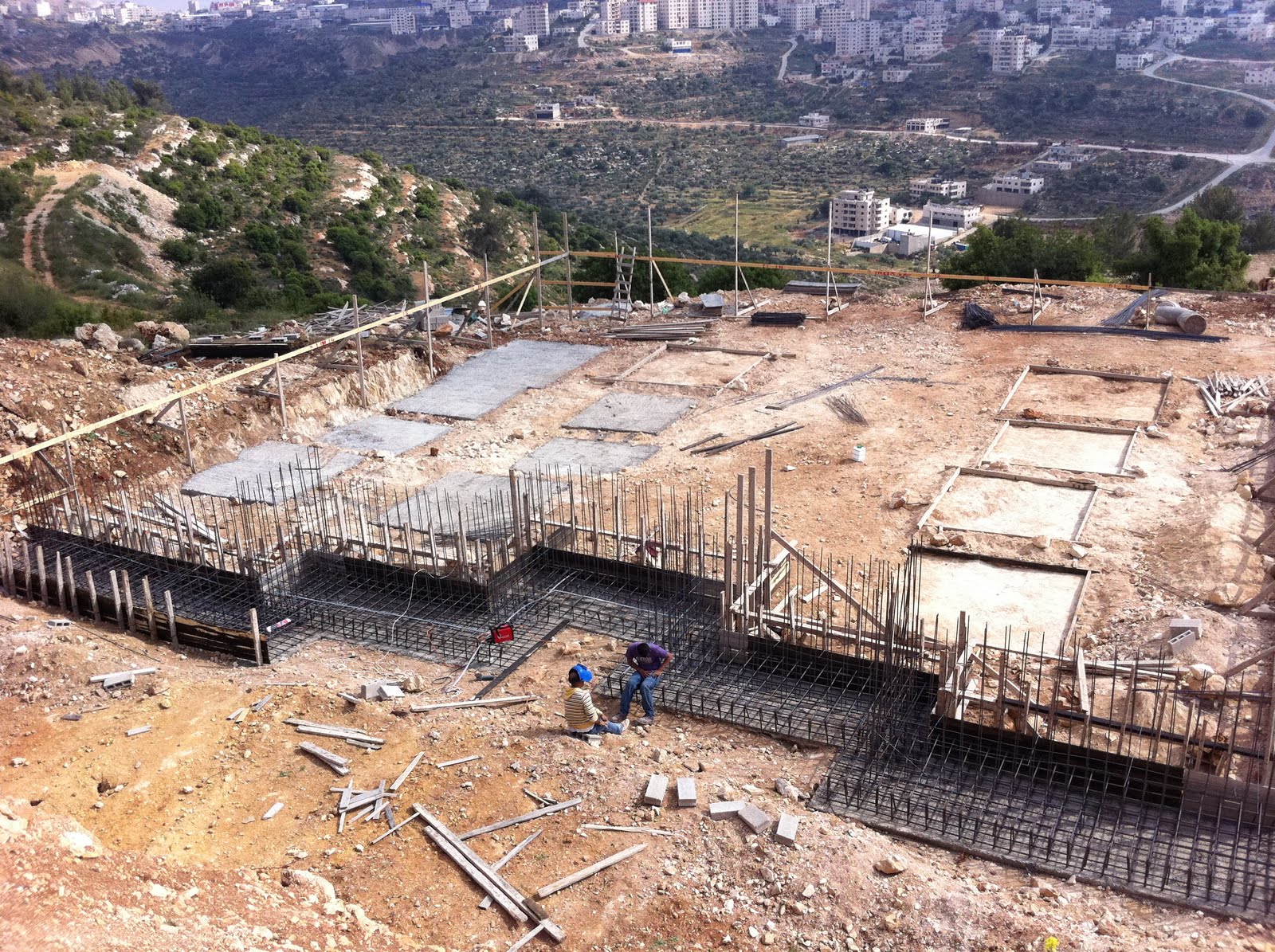
(forms around remaining foundation footings)
(crew working on reinforced steel at the base of the future stairwell)
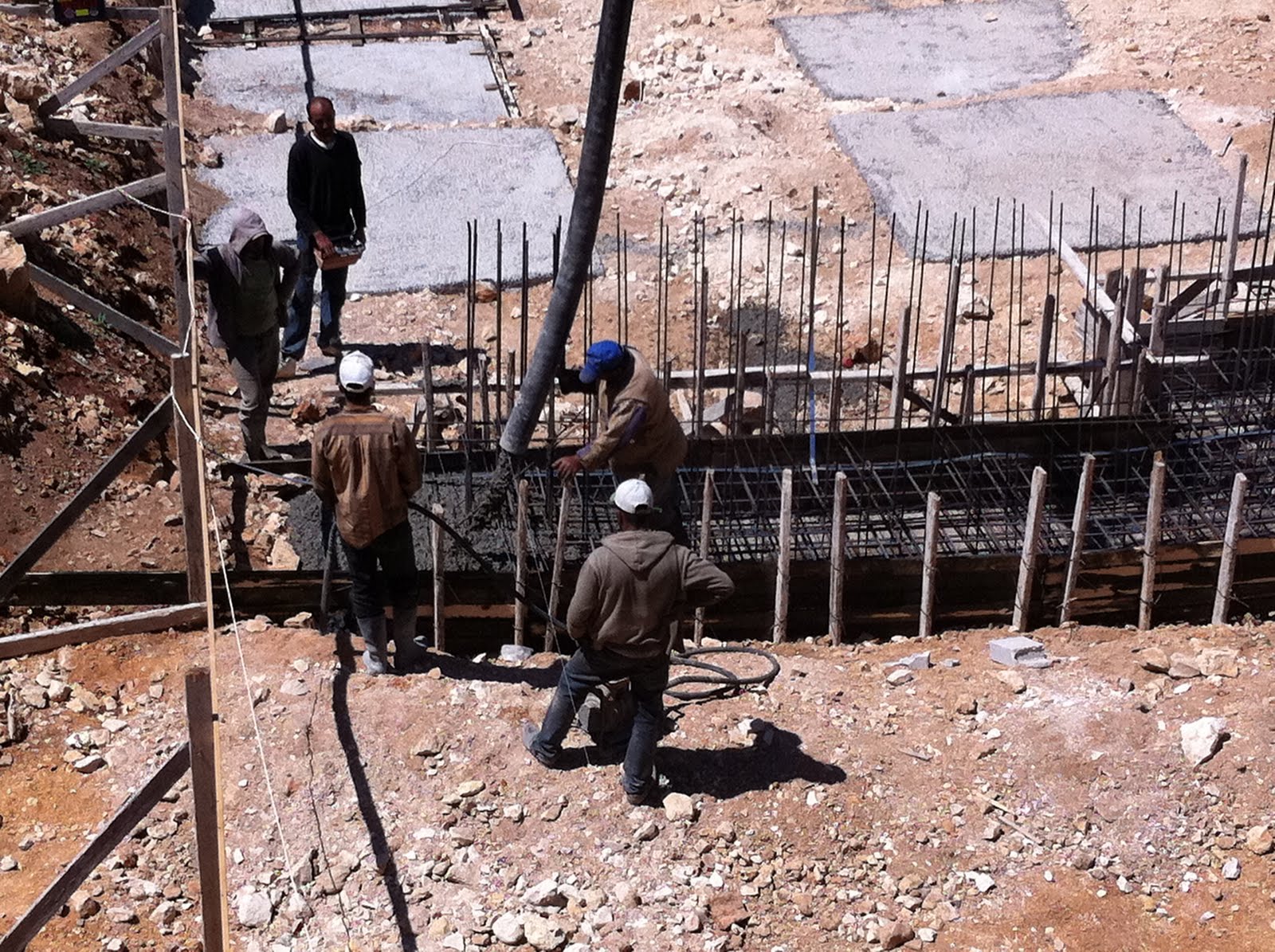
(short concrete pump needed to park closer to the forms)
(concrete pour in action)
(foundation footings have all been poured)
As for the next step in the process, the crew is preparing forms for what should be the fourth and final foundation concrete pour (hopefully Monday or Tuesday of next week), which will include the stairwell and elevator shaft walls, the column necks and the wall along the north and west boundaries. As you can see below, the forms around the columns are being constructed using concrete blocks as it is a faster that timber forms for such small spaces. The down side, obviously, is that these concrete blocks will not be re-used after the pour and their cost is offsetting the time / cost savings of the shorter construction time.
(footings completed, and forms around column necks and internal walls being erected)
The crew takes their elevation level (using a water tube level) by comparing to the marks on the 'bracelet' that surrounds the building. This will allow them to establish the height of the next set of forms needed around the columns for the fourth foundation concrete pour.
(marking elevations using a water level)
After the next concrete pour and dismantling of the forms the day after, we will be ready to import / haul in the fill material that will go around the foundations and under the slab on grade, starting to really change the way the site looks and putting the tricky (and most time consuming) part of the 'adem (frame) construction behind us.
And finally, I just had to take this picture in case anyone reading this blog is a Yankees fan. Apparently your ilk has made it to our construction site in Ramallah!
Yesterday we poured the first batch of foundation-strength concrete (B300) into the forms for the building's Foundation Wall. The reinforcement steel was laid out, tied to the foundation steel, and the wooden forms were held in place by metal wire ties as well as 6 mm steel bars connecting both sides of the forms together to withstand the pressure of the concrete being pumped into the forms.
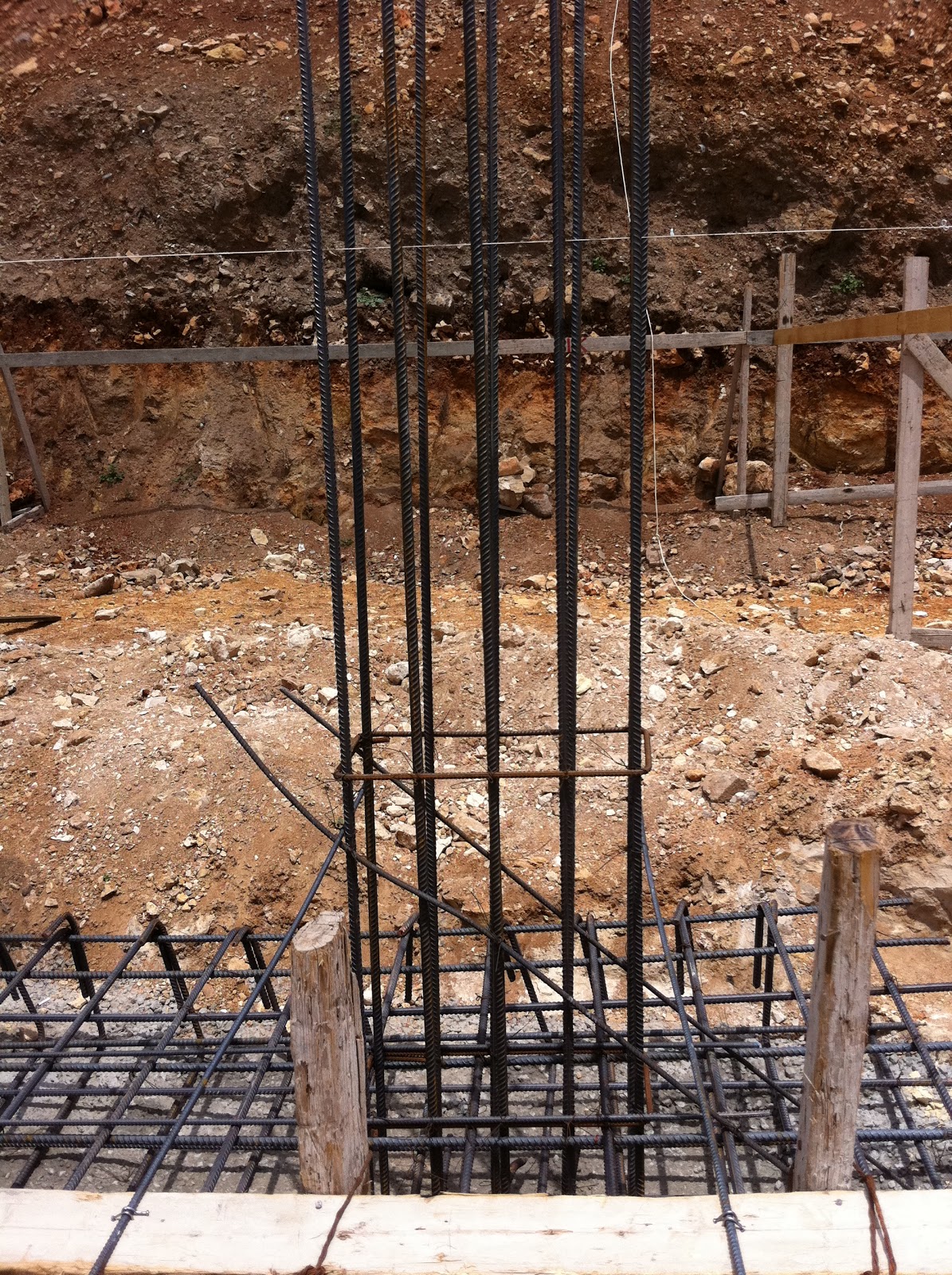
Last time I posted about being amazed by the manual labor aspect of development in this part of the world, so I thought I'd post a few more photos to illustrate my point. Here's a shot of the crew tying the column starter bars in the proper location using their tape measure and string to identify the location, metal wire to tie the bars in place, and nails, large boulders, and 6 mm metal bars to hold the wooden forms in place.
(the crew tying starter bars for columns in place)
(the starter bars held in place with metal wire ties and 10 mm 'bracelet' ring)
(the L-shaped footings of the starter bars, all tied individually to the foundation steel)
(the Foundation Wall footing, all hand-tied and placed inside the hand-made forms)
(pick axe, buckets and shovels used to clear the debris from areas where foundation will be poured)
After the Foundation Wall reinforcement steel is in place, the electricians weld a metal strip along the footing to provide an "earth" network that will ground the building and dissipate any electrical charge that might need dissipation (electric short, lightening ... etc).
(electricians welding metal "earthing" strip)
This is the site the day before the second concrete pour. Forms are in place on both sides, tied to each other and held securely in place, with steel reinforcement bars for the foundations in place and starter bars for all the columns inside the Foundation Wall established.
The morning of the pour, the general contractor is on site helping spray water on the areas that are about to receive concrete to increase moisture content and decrease the temperature a little ... then the 52-meter pump arrives and mixers start to pour cement into the pump and the pump delivers it to the foundation forms.
(contractor waters the forms prior to pour)
(concrete pump hose starting to spew cement mix)
(the crew get to work)
(workers direct the pump hose while others follow behind with concrete vibrator to eliminate gaps)
And here's a video of the process so you can see everyone in action:
The concrete had to be sampled by the geotechnical engineer in order to ensure conformance with the required strength and mix standards. The concrete blocks will be tested / crushed in two batches: once after 7 days and again after 28 days.
(concrete sample-collection blocks)
(first sample collected and labeled)
Finally, here's what the site looks like at the end of the following day. The crew cuts the 6 mm bars holding the forms together, removes all the wood frames, pulls all the nails out of the wood, then stacks it up according to size to get ready to build the forms for the next round of column foundations (the base of which can be seen beyond the Foundation Wall in the pictures below).
(Foundation Wall poured, and forms taken apart)
(crew stacking the wood from the forms for future use)
I should note that these guys work from 7:30 am to 3:30 pm, every day except Friday. The more experienced (master) workers make 145 NIS (around $41) a day, while the less experienced (apprentice) workers make 85-90 NIS (around $24-$26) a day.
Almost without exception, they love watching WWF wrestling on Thursday night television and talking about it the next week.