Showing posts with label Diplomatic Subdivision. Show all posts

Thursday, April 7, 2011

More Rain and Sunset

We've had a few more rainy days in Ramallah, and it's given us a chance to finalize our agreement with a contractor and follow up on a few more administrative items, namely:
  • Prepare a preliminary wastewater study to figure out the best way to connect to the city's wastewater system, and coordinate a service extension request with the city. We still need a consent letter from the neighbor who's property we'll need to go through, as well as a route survey just to submit our application to the city. I'm sure I'll post more about this in coming days.
  • Coordinate meetings with a graphic designer to help us with our marketing needs, including a new website design, a brochure, print ads (we're planning on a couple of newspaper advertisements in the coming months), a site / project sign design and possibly a billboard.
  • Finalize arrangements with the subcontractors who will work on the interior finish of the site office, arranging for electricity, insulation and sheetrock, and office furniture.
  • Preparing a project budget and schedule, as well as a few development scenarios to get an idea of our cash flow situation for the coming months.
  • Interview contractors for the second phase of the development. Typical construction here takes place in two stages, the building frame (called 'adem, or "bones") that includes the reinforced concrete walls and the stone facade, and the finish-out (called tashteeb) that includes plumbing, electrical, interior walls, paint and wood framing, metal work, flooring and finally the kitchen and bathroom fixtures.
There's plenty to keep us busy, but I'm excited about getting the 'adem contractor signed up and getting the construction started. Weather forecast calls for a few more cloudy / rainy days up ahead but I'm hoping we'll start work on the foundations by the middle of next week.

In the meantime, I thought I'd post a few more photos of the diplomatic subdivision from the outside looking in, as seen from the west Ramallah neighborhood of Al Tireh. You can see the massive amounts of earthwork used to nestle the subdivision into the hillside:

(diplomatic subdivision - click on image to enlarge)
For someone who values the natural beauty of this place (and all other places as well), it's sad for me to see the land planners' apparent disregard for the topographic constraints they're working within and choosing not to design with nature. We're probably an even longer way from introducing biomimicry to the design industry. 

I took the next set of photos last week on my trip to that subdivision, and I was struck by the size of the retaining walls looking out from one of the villas. These walls were probably 15 meters tall in some places (~50 feet) and we were told that the builders were asked not to fill behind them because the weight of the fill material would be too much to design support for, so instead they were using a reinforced concrete floor at a higher elevation along the wall, then only filling above that for the uphill villas. Here's a set of three photos that I crudely merged to try and give a sense of the scale:

(retaining wall at diplomatic subdivision)
As for our site photos, I have a couple from the blacksmith's visit to our site office to install a door and windows:

(new office door and windows installed)

(the view from our future office)
Speaking of views, I'll end with a sunset view from a hilltop a couple of minutes away from our project site:

(Ramallah sunset)


Wednesday, March 30, 2011

The Diplomatic Subdivision and Housing Finance

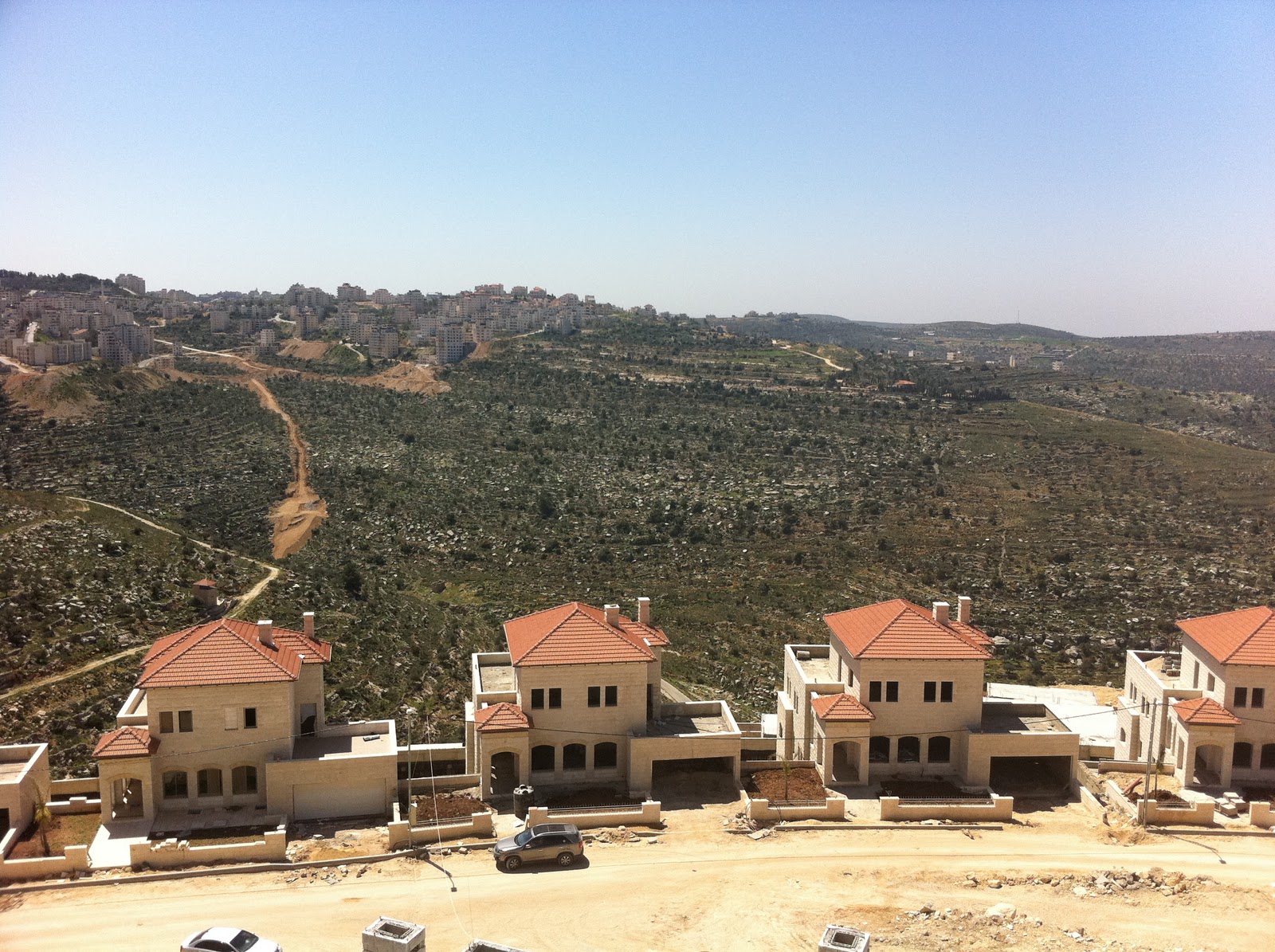
As part of our process for interviewing subcontractors (a plumbing sub in this case), we visited the Diplomatic Subdivision today. It's a residential subdivision just on the outskirts of Ramallah designated for members of the Palestinian Authority or people associated with the Palestinian Government, and the level of luxury evident in these houses made it easy to forget that the people this government is representing are living under military occupation.

Here are some photos from the trip:

(street view of the villas)

(looking downhill, with apartments at the end of the street)

(the views from the balcony of one of the villas - looking towards Ramallah)

(another balcony view - another new Master-Planned Community in the foreground)

(master bathroom inside the villa)

(master bathroom fixtures)

Development is everywhere you look. From what I've been able to gather, condominium regime laws were introduced in 1993 and really facilitated the exchange of apartment ownership, then the mortgage system began entering the West Bank (apparently brought in by Jordanian banks investing in the Occupied Territories around the year 2000), and the elements for a housing boom were in place. 

The start of the second uprising (Intifada) delayed the start of the housing boom, but as soon as the political situation started stabilizing the supply of apartments / condos began to increase and demand is projected to be at 7,000 - 8,000 units a year at a minimum (other figures I've read are as high as 40,000 per year for the next decade).

A banker colleague of mine said he read in a study that there is close to one billion US dollars "under the mattress" in the West Bank. That's roughly one seventh of the cash available to all the banks in the West Bank, and it's starting to come out from under the mattresses. The people of Palestine generally have strong saving habits, and 35 years of pent up demand are finally finding some available supply to start satisfying them.

Mortgage financing is now available through Western finance vehicles, as well as through Islamic finance institutions, and the usual terms these days are 15% down payment and 20-year mortgage. There are even institutions like the Palestine Mortgage Housing Corp. that offer 10% down payment and 25- year financing. 

As for land prices, the desirable areas have plots that are 1 dunum (roughly 1/4 acre) selling for $1M ... just the land, no improvements on it. That's on the high side, but the average is around $300k-$400k per dunum in Ramallah.

Here's another view of west Ramallah taken from the Diplomatic Subdivision. Note the expansion down into the valleys:

(view towards Al Tireh neighborhood. Note the street cuts and all the fill material dumped downhill)

(neighboring property development - again note the fill material dumping mentioned in earlier posts)

As for our little project, we finally got the water main extended into the proposed road, and the temporary water meter installed. We also got our electric meter tested and approved today, so we can officially extend power to the construction site.

(our proposed road filled back in after waterline construction)

(our new temporary water meter)

Tomorrow the blacksmith comes out to work on the mobile office, adding windows, doors and locks. Now all we have to do is find a contractor and we can get started!