Showing posts with label Construction. Show all posts

Wednesday, June 15, 2011

Fill and The Wall

The past week has been pretty exciting in terms of seeing changes on the ground, and feeling like we're moving forward at a fast pace. We imported fill material (mostly from the neighboring property where we had been storing our excavation material from March), and built the first phase of the 5.5-meter tall retaining wall that will run along the front (north) side of the property holding up the future street.

Fill and Ground Beams
The nearly 600 cubic meters of  fill material were brought in using trucks and a bulldozer, then compacted with a ride-on roller (120 centimeters wide) to achieve an acceptable density for the material that will go under the building slab. After getting off to a slow start due to a couple of holes in the tires of the bulldozer/backhoe, the subcontractor finally got rolling:

(first layer of fill mostly in place)
(bulldozer spreading the fill)
(new loads coming in)
(truck being loaded for the next run)
The driving skills demonstrated by the machine operators were pretty impressive, since these guys had to not only back up into the site each time they had a load to drop off, they did that on dirt ramps that they were building for themselves as they went along in order to get the material all the way to the back of the site.

(truck backing up into the site)
(bulldozer waiting to spread the new load)
(contractor eyeing the progress)
I'm used to hearing about fill material being compacted in lifts of 6 inches, with compaction approvals from geotechnical engineers. However, I consider myself lucky to have gotten two compaction rolls (at an average of 60-70 centimeters or 25 inches each) after we insisted, while the contractor or I sprayed water with a regular hose along the surface!

(second layer of fill being rolled)
After the compaction, the backhoe helped start the trenches (in lieu of timber forms) that will hold the reinforcement for the Ground Beams connecting all the columns, and the crew did the rest of the work by hand.

(crew digging trenches after backhoe was done)
The crew dug trenches, constructed forms on the outside of edge of the future slab pour, tied the steel bars together and built stacked rock walls along the trenches to hold the concrete in place when it comes time to pour the slab on grade. You can see a picture below of what the end result looked like for one of the Ground Beams along the east side:

(Ground Beam reinforcement and trench along east side)
 The Ground Beams will fall directly under the slab, and will be poured at the same time. Below is what the site looked like at the end of the day today, with about 85% of the pads ready for the plastic tarp and steel grid mat that will act as the moisture barrier and reinforcement for the slab respectively. However, we still need the plumbing contractor and the electrical contractor to lay their conduits and sleeves in the ground prior to covering the pads up with the steel grid mats, so tomorrow should be an interesting day for coordinating all that work.


Retaining Wall
There is a 5.5 meter (18-foot) tall, 30-meter (99-foot) long, and 40 centimeter (1.3-foot) wide reinforced concrete retaining wall designed at the front of our site, and over the past couple of weeks we've completed the work on the footing, the forms and the first phase of its construction. The base of the wall falls on two rock benches that are not at the same elevation, so we had to split the forming of the wall into two parts as well. 

The first phase is approximately 3 meters tall for an approximately 25-meter run,  the second phase will be the remaining 5-meter run for that same height, while the third and final phase will be taking the entire 30-meter run from 3 meters tall to 5.5 meters tall. The photos below show the progress of the wall construction:

(foreman eyeing the footing and starter bars for the first section that's about to be formed)

(hammering the planks that will support the forms)
(forms being erected)

(forming complete on one side, and steel being tied inside)
(steel completed, and scaffolding being built)  

(view of scaffolding from the bottom)
(starting the forms for the footing of the higher / west section)
(supports for the forms, to hold the weight of the concrete)
(the side of the footing closest to the street, formed using rocks and dirt)
(ready for the pour)
The concrete pour was slower than post foundation pours because of the restricted space for operations, plus the need to pour the 3-meter height in several lifts to ensure that the concrete is uniform, that the vibrator gets to all areas within the forms and that the weight of the concrete doesn't cause the forms to burst apart. We poured ours in 4 lifts, and poured the footing for the second (west) section of the wall at the same time.

(crews operating the vibrator following the concrete pump hose along scaffolding)
(same operation from opposite perspective)
(close up of the slow pour)
(footing being poured)
(phase one of the wall complete)
We plan to have the second phase of the wall poured at the same time the slab and Ground Beams are poured. The wall will use up about 90 cubic meters of concrete for the first two phases (including footings), while the slab and Ground Beams will use up around 50 cubic meters. The next couple of days should include the slab pour, and I hope my next post will show the floor of the second basement level completed.


Wednesday, June 1, 2011

Final Building Foundation Pour

We completed the fourth and final building foundation pour yesterday, and the crew worked quickly today to disassemble the forms on the interior walls and columns, so that the excavation contractor can start importing fill material tomorrow morning. We used around 25 cubic meters of concrete, but it was a time  consuming pour because it was all in small, constrained spaces as you can see from the photos below.

(forms and steel reinforcement are ready)
(crew standing on the forms waiting for the cement pump hose to get within reach) 
(guiding the pump truck hose along the wall forms, while crew on the ground gets forms wet)
(pouring the walls for the elevator shaft and the stairwell)
The building is starting to take shape as the exterior wall location gets defined and the elevator / stairwell area becomes more clear as well. After tomorrow, the fill material will be imported, compacted and rolled, and brought to within 10 centimeters of the future slab on grade elevation. Then we will excavate for the Ground Beams that tie the columns together, lay the steel in the trenches, place the wire mesh / grid on top of the compacted fill, and pour the slab and the Ground Beams at the same time.

(pouring the column necks to within 10 cm of the slab on grade) 
(concrete and water oozing from the forms immediately after the pour)
While the excavation contractor is doing his thing over the next 4 days, the crew will be working on the reinforced concrete retaining wall that will separate the site from the future street along the north (front) elevation. The total height of the wall will be 5.5 meters (~18 feet) with a footing that's 2.6 meters (~8.5 feet) wide. Here's a picture of the crew clearing the area for the foundation steel, while two others start setting the forms to hold in the concrete from the next pour for the retaining wall foundation. More on this to come in the next couple of posts.

(cleaning and setting forms for retaining wall footing)

Monday, May 23, 2011

Second Foundation Pour

The second foundation pour took place a couple of days ago, and everything went smoothly. We should have one more pour that includes the stair case and elevator shaft foundation, before starting to form the columns and prepare for the fill material to be placed below the slab on grade.

Below are a few photos of the rudimentary methods used in preparing and erecting the timber forms, which I continue to find strikingly old fashioned and ingenious at the same time:

(short footing edge formed with dirt and rocks)
(braces for the forms anchored with boulders)
The main element of support the crew needs during this stage is ensuring that the column and wall centers are accurate compared to the axis given to us by the surveyors, that the spacing and proper thickness of steel reinforcement bars are used, and that the layout of the steel for the column necks is correct. 

(close up view of one of the footing forms, still missing steel)
(forms completed)
(calculating steel reinforcement beam spacing and locations)
We calculated that we would need around 45 cubic meters of B300 concrete, placed the order and called the geotechnical engineer to schedule the testing crew again. They showed up a few minutes before the mixers arrived and took a sample from each mixer batch to test. After the 5 footings were poured, we ended up using 42 cubic meters of concrete.

(steel in place, concrete pump arrives with the fog from the valley)

(crews directing the pour, vibrating the concrete already placed, and smoothing the surface)
The next few days will bring the forming and steel setup for the stairwell and elevator shaft, the final foundation footing pour, the forming of the column necks, and preparation for construction of the 5.5 meter tall concrete retaining wall between the building and the street. 

Wednesday, April 20, 2011

The Time It Takes

Two months into our stay here, and I'm just now starting to get used to the pace of life in Ramallah. My initial frustrations at the slow pace of business and the inevitable delays we run into at every turn (which I was perceiving as lost time) has been replaced with the relief from the never-ending pressure of the daily grind that characterizes the rat race in the US, and the joy of spending more time with my family. I'm re-learning how to enjoy the cup of arabic coffee or mint-infused, sweet black tea served at the beginning of every meeting, the expectation that you start the meeting with discussions about anything except the business at hand, and the many other cultural norms (or "isms" as my brother would say) in the Palestinian society.

This is just how long things take here, for better or for worse, depending on how you want to look at it. I admit that I'm getting anxious to start construction, because we've had the site excavated and contractor-ready for at least 4 weeks now. But things happen for a reason, and today we find ourselves:
  • At the conclusion of partnership negotiations with a builder to to set up a contracting company and perform the development work on the project ourselves, improving the proposed Return On Investment for the overall project. This after coming within hours of signing a contract with a different, more expensive General Contractor who would not have provided the same synergies to the group.
  • Under contract with a graphic design artist to create a design for our new website, newspaper ad(s), project sign and (possibly) a billboard ad.
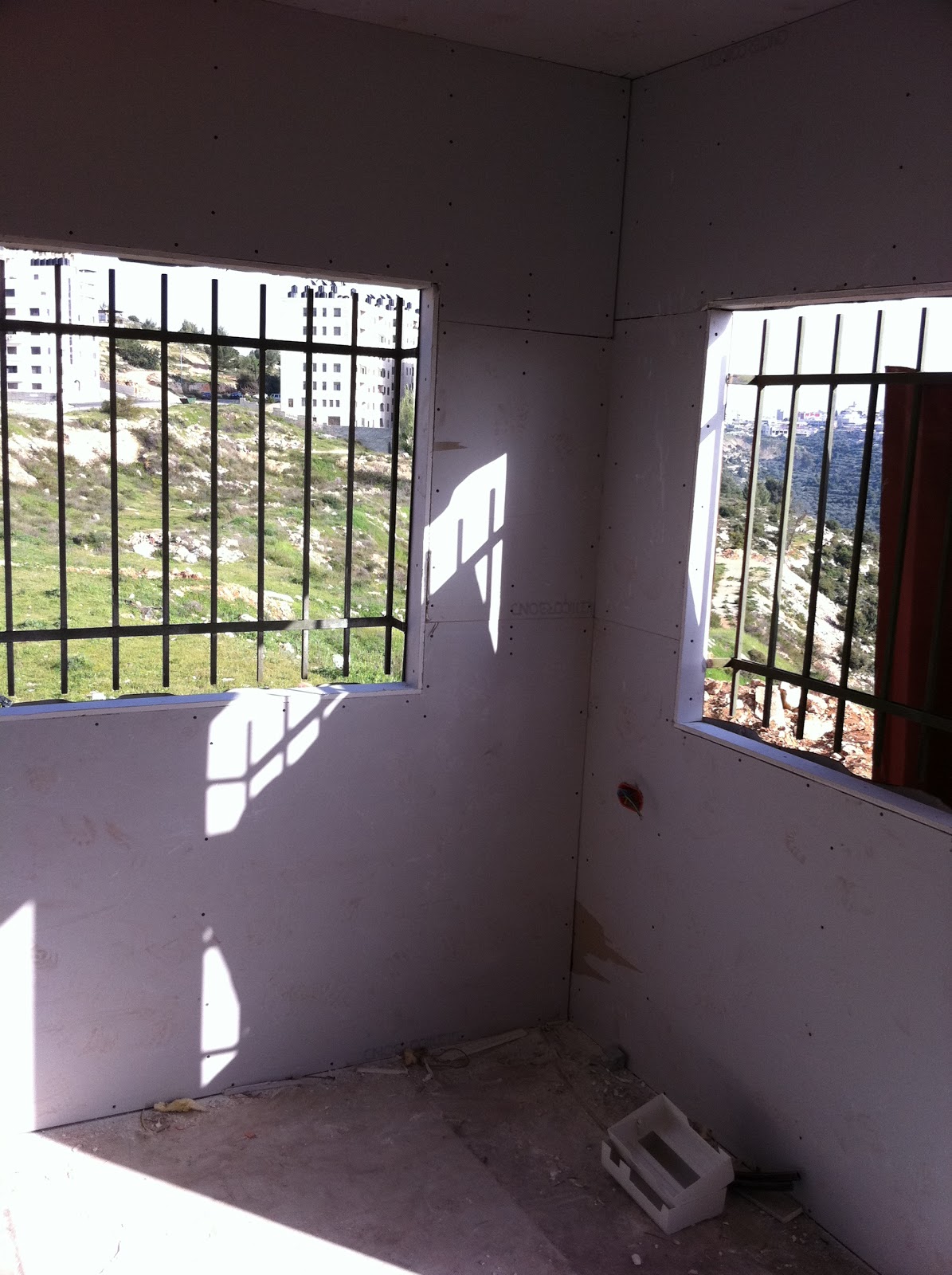
  • At the end of electric wiring, insulation and sheetrock, and window installation at the mobile office. Painting, fixtures and furniture remain to be coordinated over the next few days.
  • Having a much better understanding of our ability to finance this and future projects with the banks' assistance, and with the framework for a strategic plan for our operations for the next 5 years.
The plan as of today is to start work at the site next Monday, after the crews we hired wrap up work on another project, then the clock starts ticking. We budgeted 45 days for the first level, and 30 days for each floor after that to complete the 'Adem (frame) phase, around 8 months total for the 7 stories. the Tashteeb (finish-out) will dove-tail into it and the final two or three floors will wrap up 3 to 4 months after the framing of the roof floor.

Meanwhile, here are a few photos of the only physical activity going on at the site ... improvements to the shipping container / site office:

(frames added to attach sheetrock onto)

(work in progress)

(how many Palestinians does it take to put up a panel of sheetrock?)

(the new view from inside the - now smaller - office room,
after partitioning an area for a guard's quarters / tool storage)

Hopefully, next time I post it will be with pictures of the set up for foundation pouring. Or as we say here in Ramallah: Insha' Allah.

(With thanks for my brother for inspiring the title to this post from a song off his new album).